

Can I Use An Ipad As A Drawing Tablet
If you own an iPad and an Apple Pencil, there are several ways to pair them with your computer and transform them into a high-quality pen display for photo editing. There'southward Apple's own Sidecar characteristic, the popular app Astropad, the hardware-assisted selection Luna Display, and the "made by ex-Apple engineers" Duet Pro. I wanted to see which of these options offers the nearly features and the best experience for the lensman on the go.
Not that long agone, editing your photos with a pressure-sensitive pen on a high-resolution display meant shelling out thousands of dollars for ane of Wacom's Cintiq Pro products. Fifty-fifty now, with more affordable, lower-resolution options available from Wacom and several of its competitors, you're nonetheless coughing up a significant amount of greenbacks for a unitasker of a product that is often too bulky and inconvenient to take with y'all to a coffee store or set upwards on the tray tabular array in an plane.
From that perspective, an iPad feels like the perfect alternative. Information technology'due south small, it'southward lightweight, it boasts a loftier-resolution screen with good colour accurateness, and it offers a groovy pen experience thanks to the Apple Pencil.
The question is: how practice you do it? If you're a Mac user, is Apple's built-in Sidecar feature practiced plenty? What about PC users, what can they use? And is Luna Display—the simply choice that uses a hardware dongle to "trick" your computer into thinking the iPad is a true blue 2d screen—miles ameliorate than the competition? We got our easily on all four options to discover out.
Apple tree Sidecar
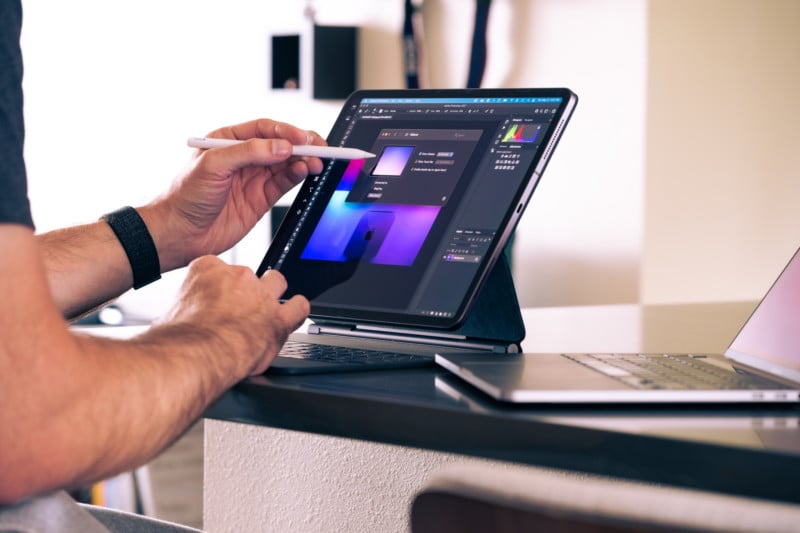
When Apple introduced Sidecar in June of 2022, a lot of people watching thought information technology was the end of tertiary-party options similar Astropad and Luna Display. Why would you pay someone else for a feature Apple was at present including gratuitous of charge? As it turns out, at that place are a few good reasons why yous might want to do just that.
Firstly, if you're a Windows user, Sidecar is out by default — the feature is only available on Mac.
Secondly, you need a relatively new iPad and a relatively new Mac in guild to go far piece of work… something I found out the difficult style when I wanted to try Sidecar on my mid-2015 Retina MacBook Pro. You lot demand a MacBook Pro released in 2022 or newer, a MacBook Air released in 2022 or newer, or an iMac released in late 2022 or newer. You also need an iPad Pro, a third-generation iPad Air, a 5th-generation iPad Mini, or a regular iPad that's six-generation or later. You can find a full breakup of compatible hardware here.
Finally, while Apple did smash the basics with Sidecar, as y'all might await, they locked it downward pretty tightly afterwards that. The shortcut keys on the sidebar tin can't be modified, there is no command over pen force per unit area curves, yous can't programme your own shortcuts, and in that location are merely a few basic gestures for pinch, swipe, and zoom. True, the iPadOS text editing gestures for undo and redo aren't limited to text, but they're not well suited for photo editing: both are three-finger swiping gestures, so when I tried to use them in Photoshop, I ended up sending my canvas off-screen by accident at least 50 per centum of the time.
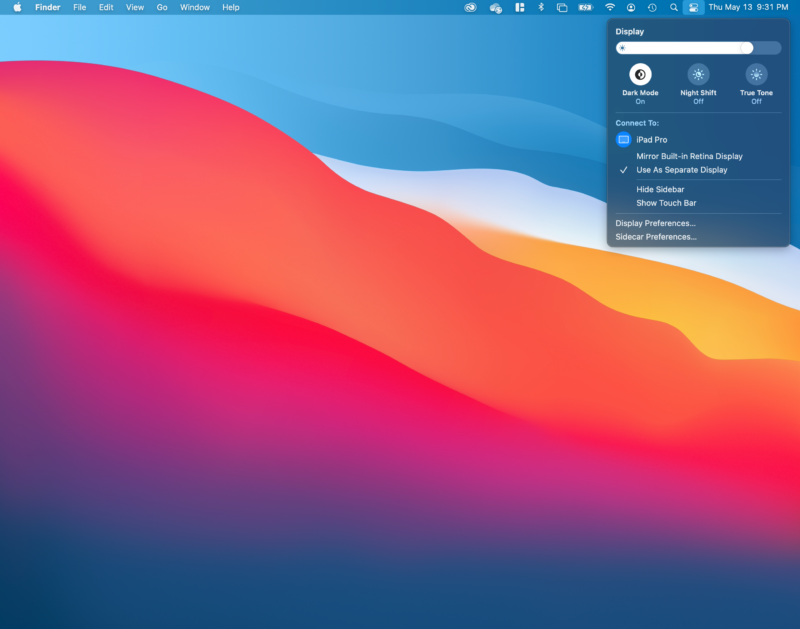
If these things aren't deal-breakers, Sidecar is admittedly a pretty sweet bargain. Later all, information technology is free, and since information technology's a part of Apple'south walled garden it performs flawlessly whether you're plugged in or connecting over WiFi. In fact, of the options I tested, it'due south the most stable over wireless. It's just limited past Apple, for Apple, and that's going to be a pain if you actually want to customize your photo editing experience with additional shortcuts, advanced multi-touch gestures, or other useful features like pen pressure curves.
Pros
- No setup required: included in MacOS and iPadOS
- All-time wireless connection of the bunch
- Total Apple tree Pencil support
- Compression, zoom, and swipe support
- Tin can be used to mirror or as a secondary display
- Information technology's free (if yous own compatible hardware)
Cons
- Little to no customizability
- Poorly optimized multi-affect gestures for Undo and Redo
- No pen force per unit area or other nice-to-have drawing features
- No Windows support
- Not supported on older iPads and Mac computers
Astropad Studio
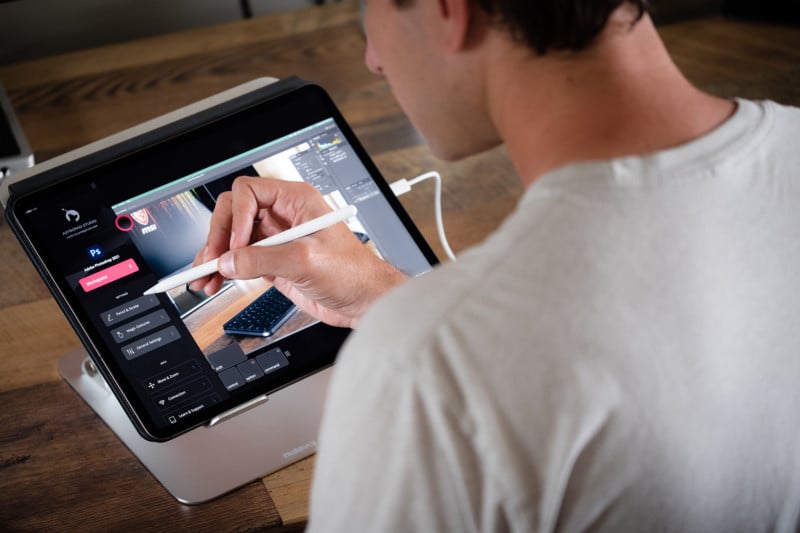
Astropad is the maker of two of today's third-party alternatives. There'southward Luna Display, which we'll talk almost in a second, and the company's namesake app Astropad.
Astropad works just like Sidecar. In that location is no hardware dongle necessary: just download the Astropad app on the Mac and on your iPad, and y'all can connect over WiFi or over a USB cable. As of March, you tin also download the public beta of Astropad for Windows, lawmaking-named Project Blue, which makes this our kickoff cross-platform selection.
Different Sidecar, Astropad is not free. You tin can selection up Astropad Standard for a i-time fee of $thirty, or Astropad Studio (which is what we were testing) for $80 per year or $12 per month.
This is very much a "good news, bad news" situation. The adept news is that Astropad includes a ton of additional gestures, unlimited shortcut sets that can exist customized by app, the ability to create custom pressure curves, and much much more than, all incredibly useful and convenient. The bad news is that you'll have to subscribe to Astropad Studio to go most of these benefits.
Astropad Standard lacks pressure bend customization, support for unlimited shortcut sets, "Magic Gestures," on-screen keyboard, and external keyboard support.
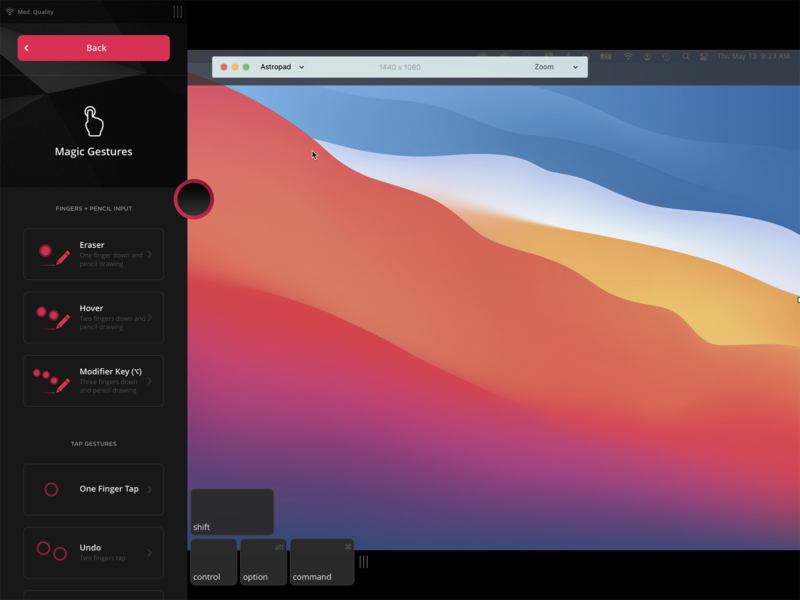
Losing Magic Gestures is particularly painful because they're then useful. These gestures allow yous to gear up 1, 2, and 3-finger taps (and holds) to diverse useful shortcuts like Undo, Redo, Eraser, and "Hover"—an extremely useful feature that lets y'all motion the mouse around with your pencil without activating the click at the aforementioned time.
Both versions use the same intuitive user-friendly UI with useful shortcuts that change based on your app, and both use the same tech to connect over WiFi or wired in over USB. Wired in, the latency is stone solid at iii to half dozen milliseconds. Over WiFi, it ranged from a best of nine milliseconds to a max of over 150 milliseconds when the connection faltered or at that place was a lot going on. The average danced effectually 30 to l milliseconds, jumping upwards to slower speeds when you tried something new and then settling in between 10 and 15 milliseconds whenever there was less activity on the screen.
Neither version can exist used equally a secondary display: even if you shell out for the Studio version, you can but mirror your display.
Finally, both versions of the app are more than broadly uniform than Sidecar. Astropad works with whatever Mac running MacOS ten.11 El Capitan or newer and allows you to utilize slightly older iPad hardware equally well.
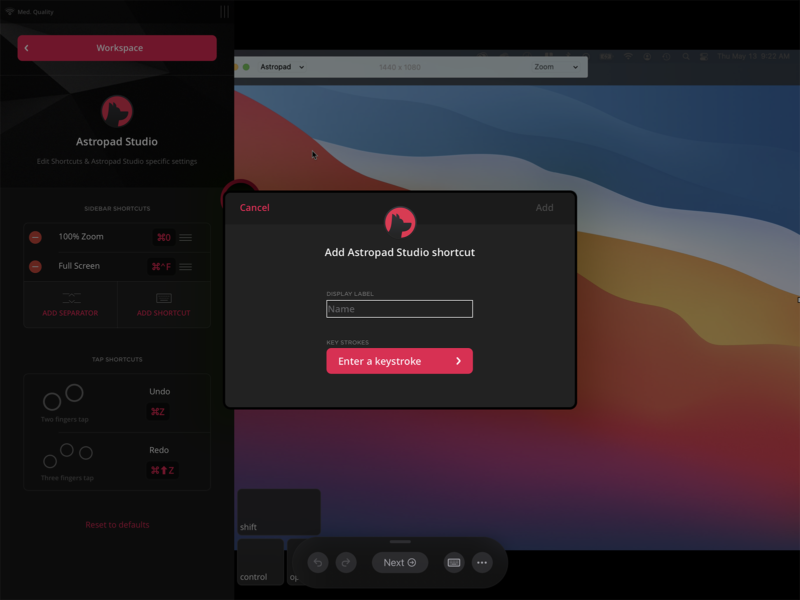
In short: Astropad Studio is leaps and premises meliorate than Sidecar, with fashion more customizations and the all-time UI of the bunch. Only at $12 per month or $80 per yr, these benefits come at a steep cost. Astropad Standard, meanwhile, is a hard sell unless you have an older Mac that isn't compatible with Apple Sidecar. I do still like the UI ameliorate than Sidecar, but without the useful Magic Gestures and/or the ability to create customized shortcuts for various apps, I'k non sure it's worth the $30.
Pros
- Seamless setup and connectivity
- Works wired or wireless
- Intuitive UI
- Support for older Macs and iPads
- Support for Windows (currently in Beta)
- Customizable pressure curves (Astropad Studio simply)
- Useful "Magic Gestures" for things similar Eraser, Undo, and Hover (Astropad Studio only)
- Support for unlimited shortcut sets (Astropad Studio only)
Cons
- On screen card "dot" tin get in the way
- Mirror mode only, can't be used as a 2d display
- Astropad Standard offers very little to justify upgrading from Sidecar
- Astropad Studio is very expensive
Luna Brandish
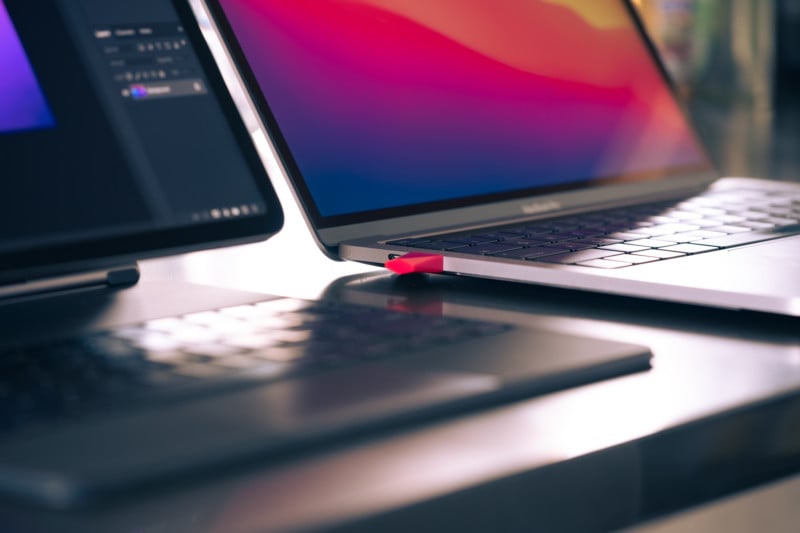
Also made by the folks at Astropad, Luna Display is the only option on our list that uses a hardware dongle instead of relying exclusively on WiFi or a USB connection. It'due south been available for Mac for some time now — in USB-C and MiniDisplay Port variants — and is currently available for pre-club for Windows as USB-C or HDMI.
On the ane paw, this allows Luna to "trick" your estimator into thinking it'southward using a real, secondary display. The dongle receives a brandish signal from your iPad or another figurer and communicates that indicate over DisplayPort protocol. On the other hand, it gives y'all i more than tiny dongle to bear effectually and potentially lose in the bowels of your backpack or camera bag.
Personally, I didn't mind the dongle, and the extra tricks that information technology enables brand Luna the well-nigh versatile option of the bunch. Not merely does information technology let y'all to plough an iPad into a second display with full touch and Apple Pencil support, it can also plow another Mac into a second display, or utilize your iPad as the main display for your Mac mini in what'due south called "headless" mode.
The same features will be available on Windows once that variant of Luna is set up to ship.
I too found that the experience — whether wired in with an actress cable, or wireless over WiFi — was equivalent to Astropad Studio… which is to say, proficient. I still experienced some stuttering when performing heavy tasks over WiFi, just had nil problems on long photograph editing sessions when I plugged in the iPad over USB. The downside here, of course, is that I was already sacrificing one USB-C port to the Luna Display dongle itself, so plugging in the iPad meant giving up another precious port.
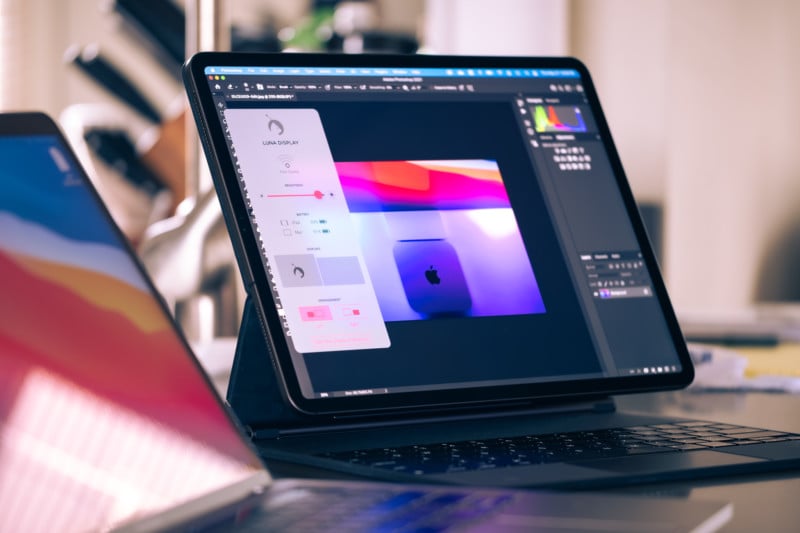
For photographers, the main downside of Luna Display is that Luna was designed first and foremost every bit a style to plough an iPad into a second display. As such, pen and bear on capabilities have a backseat. It doesn't feature any of the shortcuts you lot'll notice in Astropad Studio, no Magic Gestures, multi-touch support is limited to pinch-to-zoom and swipe, and customizability is pretty much limited to display arrangement and resolution.
Astropad patently knows that this might be an event for some users, which is why you can really utilise Astropad and Luna together if you're fortunate (or loaded) plenty to own both. Plug in Luna and turn on Astropad, and you now get Astropad's intuitive and full-featured drawing UI on your iPad as a second screen, using the Luna dongle to essentially featherbed Astropad'due south "mirror mode only" limitation.
That's groovy, simply I can't sit here and recommend that you lot buy a $130 Luna Brandish and pay $80/year for Astropad Studio, fifty-fifty if that does provide the all-time photo editing experience on an iPad. It's simply too much money. Every bit it stands, I'd recommend Astropad over Luna, and both of them together over anything else, but I can't tell yous that it's worth $210 plus $80 per year for as long as you both shall live.
Pros
- Quick and easy setup
- Works wired or wireless
- Bachelor with USB-C, MiniDisplay Port, or HDMI dongle
- Windows version available for pre-social club
- Support for older Macs and iPads
- Support for "Mac to Mac" and "Headless" modes, not but iPad to Mac
- Tin be used in tandem with Astropad
- Can exist used to mirror or as a secondary display
Cons
- Limited gesture back up
- No shortcut support
- Hardware dongle is easy to misplace or lose
- Using it wired means giving up ii ports
- The most expensive choice at $130
Duet Pro
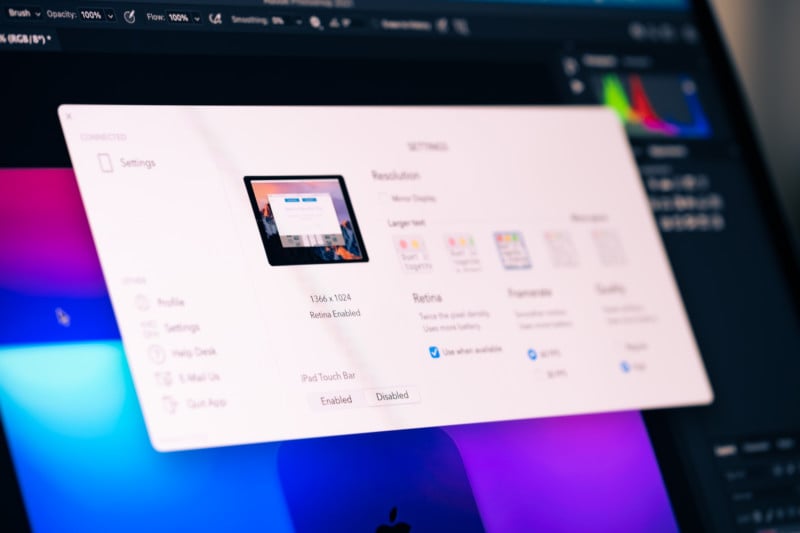
Duet Display is the last entry in our roundup, and information technology comes in three flavors: Duet, Duet Air, and Duet Pro.
Duet and Duet Air are limited to using your iPad as a second display or remote desktop (Duet Air only), with no proper Apple tree Pencil support. Equally such, they're not considered here. Our contender is Duet Pro, which will toll you $30 per yr and includes all of the important drawing features we're looking for like support for pen force per unit area and tilt, line smoothing, and multi-touch gestures.
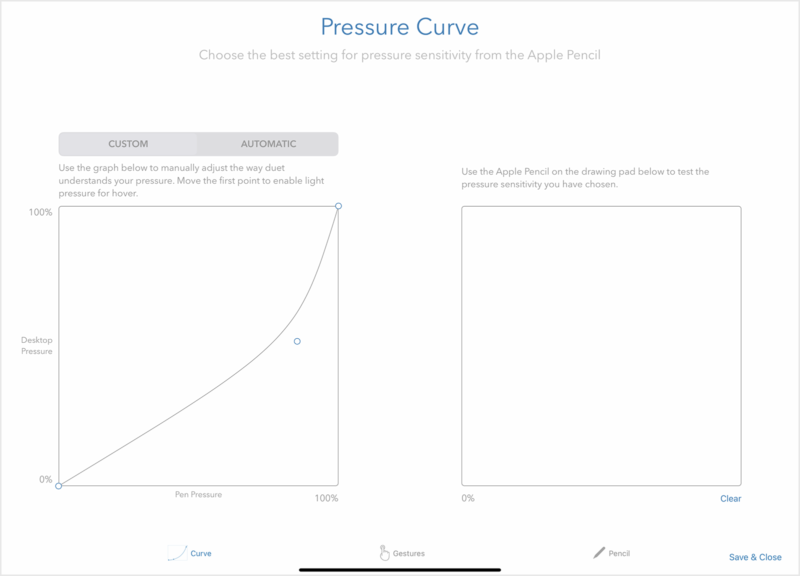
Duet Pro is like Astropad Studio if Astropad Studio could plow your iPad into a secondary display. Like Astropad, it offers lots of useful gestures, lets yous customize your pen pressure bend, and is optimized to work with photo editing and illustration applications. Dissimilar Astropad, it's not limited to mirroring your estimator's screen. It's besides the only pick that already offers full support for Windows and has for some time—no betas, no 'pre-order,' you're good to go.
Of the four options tested here, Duet Pro was probably the to the lowest degree reliable for me. It threw the well-nigh glitches, stuttered the most over a wireless connection, and once froze my reckoner solid when I tried to adjust the resolution from Arrangement Preferences instead of the Duet desktop app. Don't get me wrong, most of the fourth dimension Duet Pro worked flawlessly, just I have to mention the few glitches I experienced because the other three options were all and so stable.
Minor bug aside, Duet Pro matched Astropad Studio and Luna Display step for pace in terms of the smoothness of its wired and wireless connexion. I opted for wired most of the time for the sake of mitigating latency but could utilize information technology wirelessly in a pinch with no problem.
As far as customization and UI, it's not quite as full-featured or convenient as Astropad Studio. You can yet modify the pressure curve, and in that location are some useful shortcuts and gestures similar two-finger tap to disengage and one finger hold to hover, but the app's carte du jour is sort of "hidden" and the UI takes some getting used to.
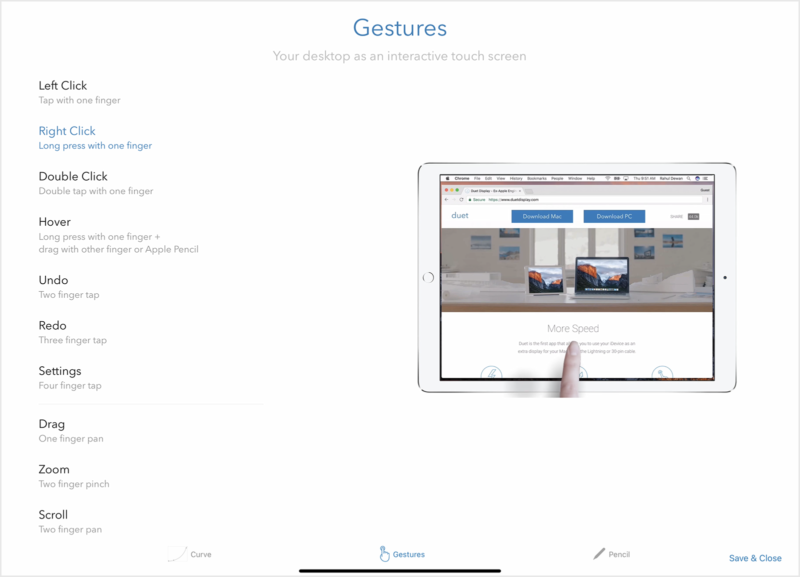
The one place where it beats Astropad outright is compatibility. Duet Pro is uniform with Macs running anything from MacOS 10.9 onward, and whatever iPad running iOS ten or subsequently will piece of work; and, as I already mentioned, it'south already fully compatible with Windows as well.
Overall, Duet Pro is a good choice if you're a Windows user and/or tin't stomach the cost of Astropad Studio. At $30/year, information technology's certainly a lot cheaper than AstroPad. But the features aren't quite as polished and the UI isn't on the same level, making it a harder sell if yous have access to Sidecar or y'all're willing to wait for Astropad to release the full version of Astropad Studio for Windows afterwards this twelvemonth.
Pros
- Easy setup
- Fully compatible with both Mac and Windows
- Works wired or wireless
- No hardware dongle required
- Tin can exist used to mirror or every bit a secondary display
- Customizable pressure curve
- Useful multi-bear on gestures
- Cheaper than Astropad Studio
Cons
- More glitchy than Astropad or Luna Display
- UI tin be a bit confusing
- No custom shortcuts
- Subscription only
And the winner is…
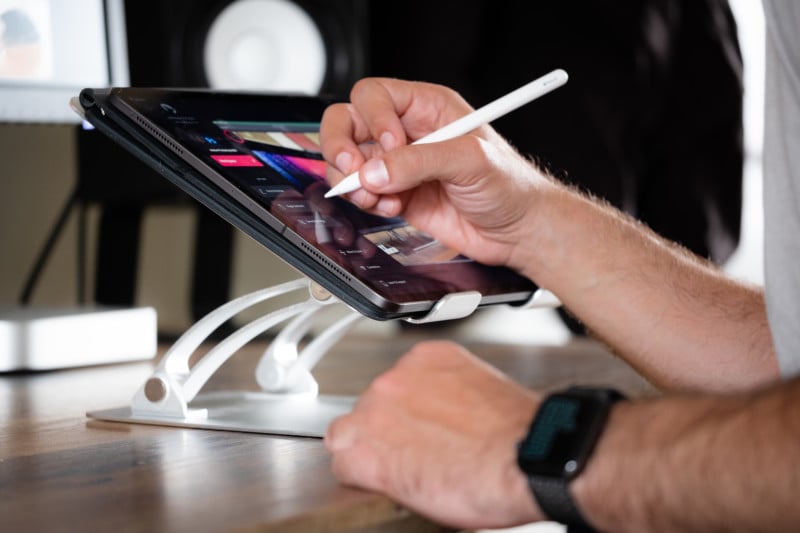
All-time Overall: Astropad Studio
For the most full-featured experience with the best support for photo editing and illustration with the Apple Pencil, cull Astropad Studio. Duet Pro can't match the sheer customizability of Astropad, and if you wind up getting a Luna Display down the route, you can use the 2 together for the ultimate photo editing feel on an iPad.
There'due south simply no comparison between using Astropad Studio and using Apple tree'south Sidecar or even Duet Pro. Astropad's commitment to creators is evident. It's baked into the Dna of this product through and through and at present that information technology's coming to Windows, I have no adept reason to tell y'all to choose another option.
I merely wish they'd sell something similar as a 1-time purchase instead of asking u.s.a. to pay $80/twelvemonth for the foreseeable future. That construction should encourage Astropad to keep improving the app twelvemonth-in and year-out, merely it likewise means that it'south only worth the cost for those photographers who are willing to integrate the app into their professional workflow.
For everybody else…
All-time for Near People: Apple Sidecar
For most people, Sidecar is good enough. It has the smoothest performance of the bunch when you're connected wirelessly, can be used as a mirrored or secondary display, supports full pen pressure and tilt, and gives yous the bare-basic shortcuts and multi-touch on gestures you demand for enthusiast-level photo editing on an iPad.
In other words: it gets the job done.
The customizability is lacking, compatibility is express to new-ish computers and iPads, and it will never exist available to Windows users. If that disqualifies you, consider spending the $30 on Astropad Standard or checking out Projection Blue. Only if you ain compatible hardware and you don't consider yourself a power user who plans to employ the iPad for serious photo editing, stick to Sidecar. Your wallet will thanks.

Source: https://petapixel.com/2021/06/01/turn-your-ipad-into-a-drawing-tablet-sidecar-vs-astropad-vs-duet-vs-luna/
Posted by: tomczaksayint.blogspot.com
0 Response to "Can I Use An Ipad As A Drawing Tablet"
Post a Comment